#sandiegosymphony

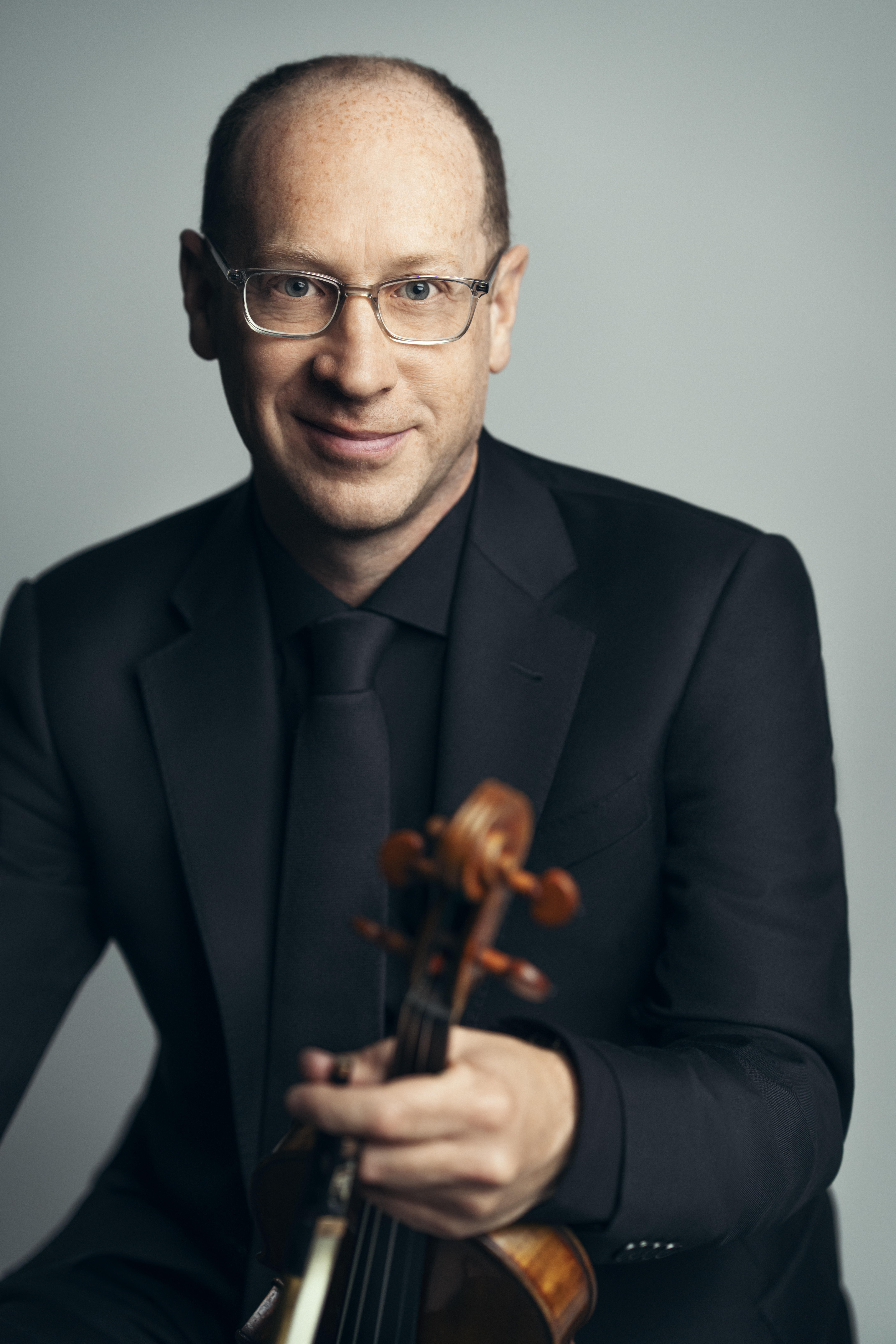
When San Diego Symphony Orchestra Concertmaster Jeff Thayer takes the stage this month as soloist in Alban Berg’s Violin Concerto, he’ll be performing the composer’s last completed work—the mystical Violin Concerto—written in 1935 “to the memory of an angel”. That angel was Manon Gropius, the teenage daughter of Alma Mahler, who died at just 18 years old.
Over his tenure, Thayer has made annual, critically acclaimed appearances as soloist with the San Diego Symphony, performing solo and duo concerti by Stravinsky, Saint-Saëns, Mozart, Bach, Bartók, Brahms, Bruch, Joseph Bologne, Chevalier de Saint-Georges, among many others.
This will be the San Diego Symphony's first performance of the Berg Violin Concerto. Ahead of this performance, Thayer shares his perspective on Berg’s deeply personal work.
As Concertmaster of the San Diego Symphony Orchestra, how does your role shape your perspective when stepping forward as a soloist?
I try very hard to study the score to the point that I can help the quick rehearsal process go smoothly, working to be collaborative and not just being in the spotlight. The soloist needs to be a partner in the process, and I always appreciate it when guest soloists take the same approach when I’m in the concertmaster chair.
The Berg Violin Concerto is often described as both deeply personal and spiritually transcendent. What draws you most to this work?
The programmatic inspiration that led Berg to accept the commission is both beautiful and heartbreaking. Dedicated “To the memory of an angel,” the work unfolds with innocence, tracing Manon’s short life and ultimately arriving at a tormented yet spiritual conclusion, reflecting her death from polio at 18.
The entire concerto lives between these two emotional worlds—an idea embedded in Berg’s 12-tone row, which alternates between minor (sadness) and major (happiness) triads.
What first sparked your connection to this concerto?
I initially connected with this work through the tonality and the musical language. I wanted to explore how Berg develops his 12-tone row in a way that remains extremely romantic in nature. There is exquisite beauty in his music while, in 1935, he was pushing the boundaries of western music with new compositional techniques, textures, and colors.
You perform on the remarkable "Bagshawe" Stradivarius violin, made in 1708. Have the possibilities of the instrument, and your discovery and development of them influenced your approach to the Berg as far as sound capabilities and interpretative options?
The “Bagshawe” Stradivarius offers an extraordinary range of color—something that has deeply influenced my approach to the concerto. One of the defining characteristics of Strads is their vast tonal palette; while it takes work to uncover those possibilities, the range of color they can produce is remarkable.
In Berg’s concerto, this becomes especially meaningful, as the piece makes frequent use of open strings and spans a wide emotional landscape. From the violinist’s very first entrance—built on the most basic tones of the instrument—the sound begins to evolve and expand. Having access to such a rich spectrum of color allows me to more fully explore those shifts in character and expression. It is truly a joy and a privilege to play on an instrument with so many possibilities.
What do you hope listeners take away from this performance?
I hope audiences will share in my admiration for the piece—not only as an important 20th-century concerto, but as a profound work of art with enormous depth.
For your annual solo appearances, what violin concertos are still on your bucket list?
The violin has such a rich repertoire, and there are many works I look forward to performing, including concertos by Béla Bartók (performing Violin Concert No. 1 next season on May 29 and 30, 2027), Ludwig van Beethoven, William Walton, Robert Schumann, and Karol Szymanowski.
FOR TICKET SERVICE E-MAIL
TICKETS@SANDIEGOSYMPHONY.ORG