FOLLOW US
#sandiegosymphony

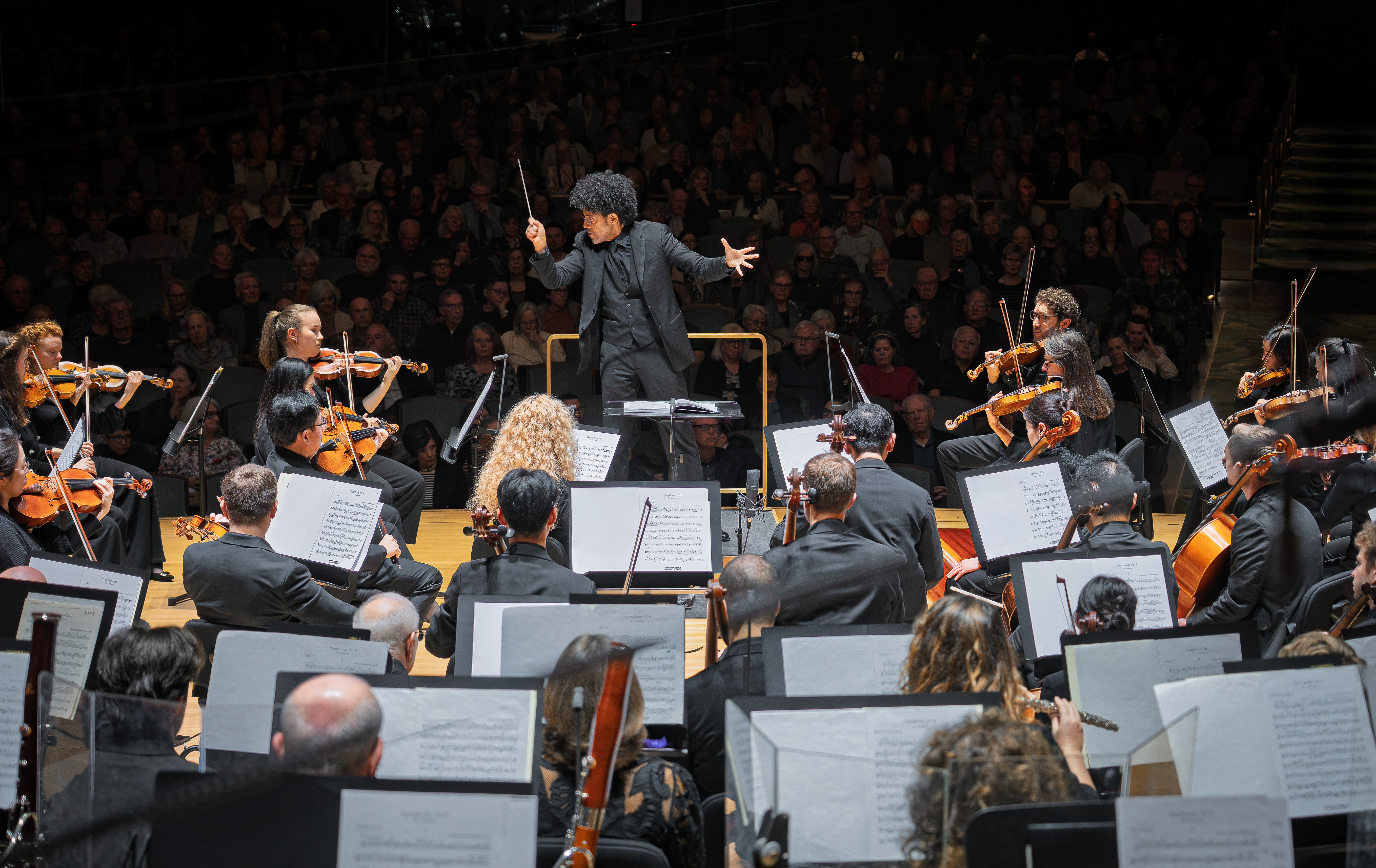
"There is something fantastic that has happened with Shostakovich's music that, today, it speaks very, very loudly," said Rafael Payare, San Diego Symphony Music and Artistic Director.
This weekend, the Symphony is set to perform Shostakovich’s Tenth Symphony, first at the Segerstrom Center for the Arts in Orange County, followed by two performances at Jacobs Music Center.
Shostakovich is a composer Payare often gravitates toward, and works that are frequently programmed by the San Diego Symphony.
The Symphony has now released two recordings of Dmitri Shostakovich, most recently his Symphony No. 7, "Leningrad," noted by Gramophone Magazine as one of the best recordings this year. In 2022, Payare and SDS released Shostakovich’s Symphony No. 11, “The Year 1905.” Later this season, a February concert will include Symphony No. 5. Payare will conduct Shostakovich’s Violin Concerto No. 1 in March (with violinist Joshua Brown) as well as on the Symphony's debut European Tour in April and May, featuring renowned violinist Leonidas Kavakos.
We sat down with Payare at the beginning of the season to talk about his Shostakovich selections.
If someone has never heard Shostakovich’s Tenth Symphony, what would you want them to know before they hear it?
In Shostakovich, especially with this symphony, he was attacked twice by the regime and was qualified, at one time, as an "enemy of the people." Then he came back with his Fifth Symphony and was sort of forgiven, but then—after doing the Seventh and Eighth Symphony—they demanded that he do a Ninth symphony. It was the shortest of his symphonies; the most sarcastic and the smallest of all of them.
Again, for Shostakovich, this was kind of his resilient way of saying, "No, you are not going to tell me what I am supposed to do. Have that!"
So, he was condemned or punished, "You are only going to be writing music for propaganda films and things like that, small ones." So there was a period that Shostakovich—from the Ninth to the Tenth—there was nothing he could do until Stalin died.
Stalin died at the beginning of March 1953 and then Shostakovich started his Tenth Symphony.
The amazing thing with Shostakovich is that he always used cellos and basses as the inner thought, like looking at himself in the mirror in the morning and thinking out loud. At the end of the last movement, he goes immediately to the cellos one more time like "I survived, but what happened to the one that did not survive? Am I the same, or am I just a shell of a person?"
All of this that is happening in here [his head] and he's not whining. He's not saying, "Oh, poor me." That's the amazing thing with Shostakovich—he just depicted what had happened. Life is like that and he just keeps going forward. You could hear or feel all the ghosts of friends.
Things just go from there until he was just like "You know what? I could go now to your grave and step on it." It changes everything and he makes much more mockery with the bassoon. [Shostakovich is saying] "You thought I was going to be a malbarist [juggler]. I am alive and you are not." And it ends in a completely different way. It's not joy, but it's different, like "I survived and there's still hope." It's fantastic.
You’ve chosen to invest so much of your energy, and the orchestra’s energy, in Shostakovich at this point in the San Diego Symphony’s journey. What does this music have to say to us now, and what do you hope audiences in San Diego will take from it?
"There is something with Shostakovich's music that is not only the portrait of an era when it happened, but also how the human soul could have resilience even in the most terrible times, or the most divisive time that could happen. Somehow, in a very beautiful and utopic way, the human soul could actually overcome all of this and see some hope and go a little bit further.
With the siege of Leningrad—that is portrayed in the Seventh Symphony—we could hear from the very beginning, even though the soul has been beaten up, how it just comes back after this whole terror and everything. And it doesn't mean that it's going to change the past, but it could at least hope for a better future. And that is something that is very, very important to have nowadays. It's like a silent, very, very loud message that I think we should have. That's why it is very, very important to have this music play now.
Both of the November 14 and 15 concerts are sold out, but tickets are available for February's concerts featuring Symphony No. 5 and March concerts including Shostakovich’s Violin Concerto No. 1.
The San Diego Symphony's recording of Shostakovich Symphony No. 7 (Live) continues to receive praise from critics. A recent review from Italian outlet Music Map called the recording "more than simply another addition to the discography of this monumental work: above all, it is a declaration of artistic intent." (English translation)
The recording also landed on Gramophone's "The Best Classical Music Recordings of 2026 (So Far)" list published in November.
FOR TICKET SERVICE E-MAIL
TICKETS@SANDIEGOSYMPHONY.ORG