FOLLOW US
#sandiegosymphony

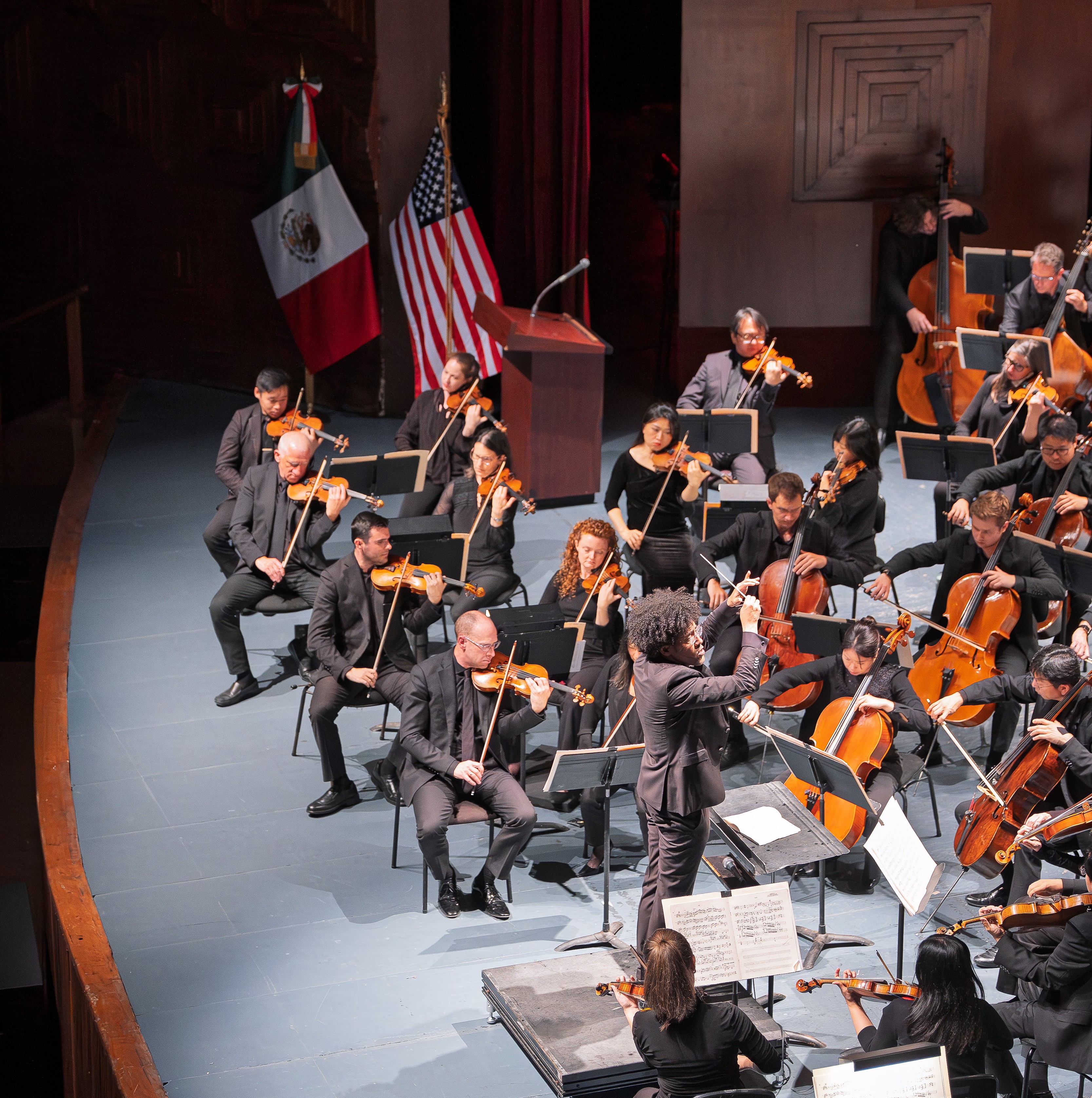
San Diego’s Musical Connections Across North America
San Diego knows something about borders.
The border with Mexico is a defining part of life here. Families, artists and communities have connections on both sides, and the region’s cultural life reflects that exchange. For the San Diego Symphony, those connections have become more than an observation about where we live; they have shaped how we think about our role as an orchestra.
The Symphony’s relationship with Mexico goes back to the 1960s. In recent years, that relationship has taken on new energy, with the Symphony expanding its work with artists, students and cultural organizations in Baja California. Musicians have traveled across the border to share music, ideas and experiences, strengthening something that has long existed naturally in our region: a cultural connection between San Diego and Mexico.
This summer, Symphony musicians traveled to Mexicali and Tecate to work with students in Baja California’s Sistema music education program. This October, the full orchestra returns to Tijuana for its second concert at CECUT this year.
And now, we’re also looking north.
The relationship between the San Diego Symphony and the Orchestre symphonique de Montréal represents the next chapter in that work, pointing toward a broader cultural network connecting artists and audiences across Mexico, the United States and Canada.
The next chapter is Montréal
Montréal might seem like an unexpected addition to San Diego’s border story.
In this case, there is an especially human reason the connection between San Diego and Montréal is natural.
Rafael Payare.
Payare is music and artistic director of the San Diego Symphony and music director and artistic director of the Orchestre symphonique de Montréal.
The two cities where Payare is musically anchored could hardly look more different. San Diego sits beside the Pacific Ocean and the U.S.-Mexico border. Montréal lies on an island in the St. Lawrence River, in predominantly French-speaking Québec. Yet both are places where more than one language and cultural tradition shapes daily life.
Payare’s connection to both orchestras creates opportunities for musicians and audiences to encounter one another’s music, and for San Diego’s longstanding ties with Mexico to become part of a wider exchange across North America.
One conductor. Two orchestras.
When the Orchestre symphonique de Montréal comes to Jacobs Music Center on October 29, Payare will conduct the orchestra he leads in Montréal in the hall where he has built an increasingly distinctive artistic identity with the San Diego Symphony.
For San Diego audiences, there is something special about that.
We aren’t just welcoming an orchestra from another country. We’re welcoming an orchestra that is part of our extended musical family.
Montréal is also bringing its own voice. The program includes music by Montréal-based composer Samy Moussa, Tchaikovsky’s Violin Concerto featuring violinist Leonidas Kavakos and Stravinsky’s The Firebird.
The following evening, Friday, October 30, the two orchestras will come together in a different way. In the free concert Sound of Two Cities at The Rady Shell at Jacobs Park, musicians from the San Diego Symphony and the Orchestre symphonique de Montréal will perform side by side on the same stage.
It is a simple image, but a powerful one: two orchestras, two cities, two countries, making music together.
One composer, two orchestras
There is another connection between San Diego and Montréal: Jimmy López.
López is composer-in-residence with both the San Diego Symphony and the Orchestre symphonique de Montréal. In 2027, that shared relationship will reach an important milestone when both orchestras perform his Symphony No. 6, Monarch, co-commissioned by the two organizations.
In San Diego, Monarch will bring the Symphony’s season to a close, performed alongside Beethoven’s Ninth Symphony.
It is a fitting way to bring this story together.
A composer whose life and work cross borders. Two orchestras in two countries sharing a new work. A conductor with deep artistic ties to both ensembles. And audiences in both cities hearing the same music performed by their own orchestras.
A composer writes music that travels. An orchestra crosses a border. Musicians learn from one another. Audiences discover connections they may not have expected.
We can preserve great works from the past while creating new ones for the future. We can honor the traditions that shaped us while inviting new voices into the conversation. And we can build relationships across borders while celebrating what makes each place distinctive.
From San Diego, those relationships can reach in more than one direction. They deepen our understanding of the places and people around us, including our own.
Three countries. Many histories. Many voices. Many connections.
FOR TICKET SERVICE E-MAIL
TICKETS@SANDIEGOSYMPHONY.ORG