#sandiegosymphony

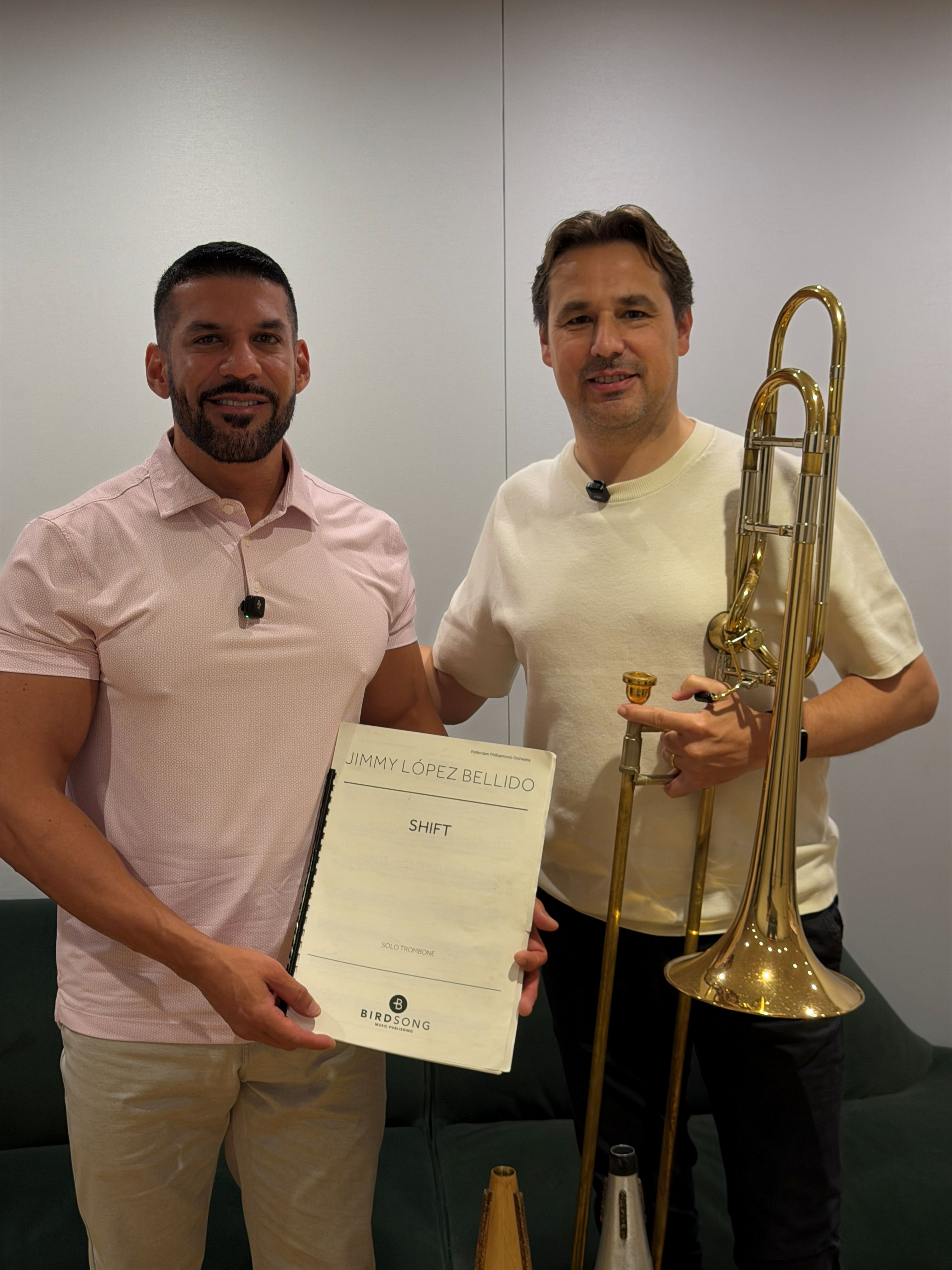
San Diego Symphony Composer in Residence Jimmy López discussed the inspiration behind his trombone concerto Shift alongside dedicatee and soloist, Jörgen van Rijen.
Shift was co-commissioned by the San Diego, Rotterdam, and San Francisco symphonies. It is one of two pieces composed by López and co-commissioned by the San Diego Symphony to be performed this season.
We don’t often hear the trombone featured as a concerto soloist. What drew you to write a concerto for it, and what sides of the instrument did you want to highlight?
Jimmy: I was approached by Jörgen a while back, shortly after the pandemic, and he wanted to work on a project that was more chamber music. At that point, I wasn't able to join. I said, "if you ever come up with an idea of a concerto, I'm here," because I knew he was a wonderful soloist and orchestra player. So, a few years later, the initiative came out of me, in a way, because I was walking the streets of Lima, and I heard this incredible honk that was really kind of strange and quirky, passing at a very high speed. Of course, that's the Doppler effect—that's what we hear when we hear an ambulance running or a police car going by. For some reason, that sound stuck to me and I was like, "What if I ever wanted to bring this to life with an orchestra, with music, with sound?" I could not figure out what could ever bring that sound to life, and everything that it implied. Then, I remembered my conversation with Jörgen, and I thought, wouldn't this make an interesting seed for a trombone concerto? Because that's the one instrument that I think can pull this off. And of course, there's so much more to it.
We know the trombone from the heroic, the epic, the grand sound, but there is so much more to the instrument. There's so much more than just the glissando, as well. That's why the concerto, that has very distinct movements, explores a different side of the instrument. Also, it reaches levels of agility that are not usually associated with the trombone because the trombone is usually seen as a somewhat heavy instrument. But you will be surprised at the amount of double and triple tonguing in this concerto that not every soloist can actually sustain for that long, so that's a challenge as well. Then there's also the melody, right? The melody, and the cantabile, and the extreme register that the instrument has—because we usually hear it at the register where the instrument is most effective, which is what composers do in orchestra. When you have a soloist, you can actually go to the extreme regions, really high up or really low down, where the instrument achieves a different kind of timbre that audiences are not used to experiencing.
What was your first reaction when you played through Shift? Did anything surprise you?
Jörgen: Well, first reaction was "wow, this is difficult." It's many notes, but also directly, I had the feeling this can be really, really great and really nice, and it really features the trombone in a way that is not done so often. I think most people in the audience will know the trombone from the back of the orchestra when it gets loud and big, which we love to do also. But a lot of people don't know that it can be light and virtuosic, and also melodic and singing—there were a lot of those qualities in this piece, and a lot of virtuosity, a lot of fast tonguing, where it is nice to show that to an audience.
One of the things I love about being a trombone soloist is that audiences don't know the possibilities of a trombone normally. From a violin or a piano, they know the possibilities, and you can surprise with how great you play or how beautiful you play, but you cannot so easily surprise with the possibilities of a piano or a violin. I think with the trombone concerto, you can really surprise. People have no idea going to a trombone concerto what it is going to be, and this shows a side of the instrument that people probably never have thought of, which is really a nice thing to do. So that's what I saw directly from the beginning, like "this is going to be nice to work on and nice to present."
This piece explores sound, water and light. Can you pick one and tell us how you turned it into music?
Jimmy: I'll pick light, and the reason why I do that is because I like experiencing or expressing one medium through another. I’ve written works in the past that explore synesthesia, which is when two different senses combine. In this particular movement, what I'm trying to express is basically the ethereal quality of light through sound. That forced me to kind of find the kind of orchestrations and instrumental combinations and articulations for the orchestra and ways of playing that were as light and ethereal as possible, and also for the trombone. So, I enjoyed this movement very much because it really forced me to look into something that we cannot usually grab, it's something that we cannot see. It's present, you know, but it goes at a speed that we can't perceive. So, it was interesting to try to grab what is usually out there and impossible to understand. The thing about the Doppler effect is how light behaves in the same way that it does in other mediums, in waves. In astronomy, the Doppler effect is used to measure the distance of stars, for example. So, we have the Redshift, which means that's when the stars and galaxies are more distant, and the Blueshift is when they are closest to us. So, I'm trying to play a little bit with that, the distance and the closeness of that, and the ethereal quality of light.
Jörgen, how do you bring that to life on the trombone?
Jörgen: This lightness is very, very clear in that movement, and it's very directly clear how it should sound, which is sometimes a little difficult on an instrument that is easily heavy. So I try to emphasize the lightness and the leggiero, the thinness of the music. It's almost like a bit of swing in there with the orchestra. So I really like to connect to the basses and to what's going on in the orchestra and sort of dance on top of it very lightly. That's, I think, the idea.
Jimmy: Yeah, it's a very dance-like movement. Very groovy. I would say.
The final movement is called Sonoluminescence. What does that mean, and how does it bring sound, water and light together in the music?
Jimmy: So that's something I discovered while I was writing and researching the Doppler effect. It's not directly connected to the Doppler effect, but the reason why I brought it there is because it brought those three elements together in a very interesting fashion. So, sonoluminescence is a phenomenon when you have a bubble of air or gas that forms within a liquid, let's say water, and because of the amount of pressure, it heats up to incredible temperatures, and then it bursts with such force that it emits light. This has been observed in the laboratory, but it was actually observed in the natural world for the first time only in the early 2000s, if I'm not mistaken. This is the mantis shrimp who does that—clicks its claws with such power it can kill a small animal because of that impact. That claw creates a bubble of air that just bursts and emits light. That was fascinating to me, that those three elements combine to create a phenomenon that I didn't think was possible. That also gave me kind of a musical cue, of sorts, because this very powerful first impact is what I'm trying to reflect in this movement. So, you have this gesture from the orchestra that combines the harp with buzz sound, the vibraslap [percussion instrument], and others like the pizzicatti [plucking strings], and Bartók pizzicato [plucking a string so it slaps on the fingerboard], all these things that actually can create these explosive sounds. I ask the same from the trombone, and then with the kind of bouncy remnants of the sound that follows. That was really fun to write as well—a musical idea I wouldn't have come up with on its own, but that actually was inspired by this extra musical element.
What’s one moment in Shift you’d tell the audience to listen for—and why?
Jörgen: It's difficult to pick one moment because that makes the other moments less important. I think the whole piece together, like you [Jimmy] explained—in the last movement, the three before come together. With the material of the three first movements, we come to that effect of the bursts and the bounciness. So, it's not easy to say one moment. I love the whole piece. But in the second movement, Water, there is this glissandi, which is something that is connected very often to the trombone, but in this way it makes a lot of sense because if you move through water, you have this sort of slowness to it, and a melody comes out of that. That, I think, is one of the most beautiful. Except for the excitement of the virtuosity of this piece, one of the things I love the most about the trombone is the singing quality of it, and that is really in the second movement, in this Water. Often the glissando in trombone is used a bit in a fun way, like always the joker of the piece, but in this, it's really used in a very musical, very lyrical, melodic way, which creates something that I think is special to the trombone and that I love.
Jimmy: Actually, I would pick the same. I would, because again, the glissando is so inherent to the trombone, but I also didn't want to use it in a caricature way, or in a way that it's generally used. So, I actually had many doubts about placing that many glissandi in that movement. Initially, I wrote them and I deleted them, and I was like, "maybe legato is enough to express the qualities?" But, then I said "No, you know what? This is perfectly justified." So, I like musical ideas that are not gratuitously placed in the score, but that actually come out of necessity. I felt that the whole expression of, or the metaphor of, moving through water, and the effort that comes with it, very much was pictured through those glissandi, and out of it came these beautiful melodies.
---
The San Diego Symphony presents Shift October 16 and 17. Buy tickets here.
FOR TICKET SERVICE E-MAIL
TICKETS@SANDIEGOSYMPHONY.ORG